

Being Human is Hard
Or… How cultivating hope can make life easier

Being human is hard, and it’s often hope that gets us through the day. Hope for change, for something better, for something different—hope for the future and a day when life can be less hard, less challenging. It’s this little bit of hope that we draw on—often without even realizing it—that keeps us going.
Sometimes, hope seems like a “big thing”—more aspirational than inspirational. It’s something that is just out of reach, especially when we are going through really rough times. The thing is, true hope—everyday hope—is always with us, even when we can’t see it. Thankfully, it has a tendency to show up on its own. It’s often the quiet voice or pinprick of light that becomes clear when we slow down enough to hear and see it—to let it in.
“Everyday hope is... the quiet voice or pinprick of light that becomes clear when we slow down enough... to let it in.”
So, what is everyday hope, really? It’s the connection and relatability we find in sharing our own and listening to others’ stories. It’s these narratives that remind us that we’re all human, that being human is hard, and that we have done and can continue to do hard things. Everyday hope is rooted in what it means to be human: our shared experiences.
For the past 20+ years, I have been helping people find this kind of everyday hope through my writing and coaching. Though I may not have always labeled it this way, nearly everything I have done—and continue to do—has centered around hope. Sometimes that shows up directly—like when I teach or share insights that help someone reframe their thinking. And sometimes it shows up indirectly—like when I share stories of failure and resilience from my own life. Through it all, the underlying message is always about hope: Finding, restoring, and remembering it.
Hope is the superpower every human is born with (I think it’s part of our DNA!), and it’s almost always delivered through story. Stories are the places where we can find hope when things feel overwhelming. They are the repositories of our dreams, our lessons, and our collective humanity. They are where we find comfort, validation, and inspiration. They are the vehicle that reminds us of hope when it feels out of reach.
“Stories are the places where we can find hope when things feel overwhelming.”
I’ve always loved words. If you’ve been reading me for a while, you know how much I enjoy being a writer and am inspired by other writers. I have collected quotes for as long as I can remember and love sharing them throughout my work.
You’ve also seen my blog undergo some shifts. Even though the themes remain mostly the same, the packaging has changed. It all began in 2009 with InspireBytes™—which I eventually turned into a boutique publishing company to share the inspirational voices of others. From there, I moved my blog to my website for a brief period before I created Unique and Universal on Substack—my new writing home. While I loved that title (you can read about what it represents here), I came to accept that it didn’t easily capture what I write about. I realized that if I wanted to help more people find hope in their every day, I needed to make it easier to find.
Then, last Fall, I started working on an old manuscript. It’s a book I’ve been writing (off and on) since 2016 with the working title of Being Human is Hard. Because it is! After two decades of coaching, I can honestly say that all of my clients have uttered something along these lines at one time or another. It’s a simple truth.
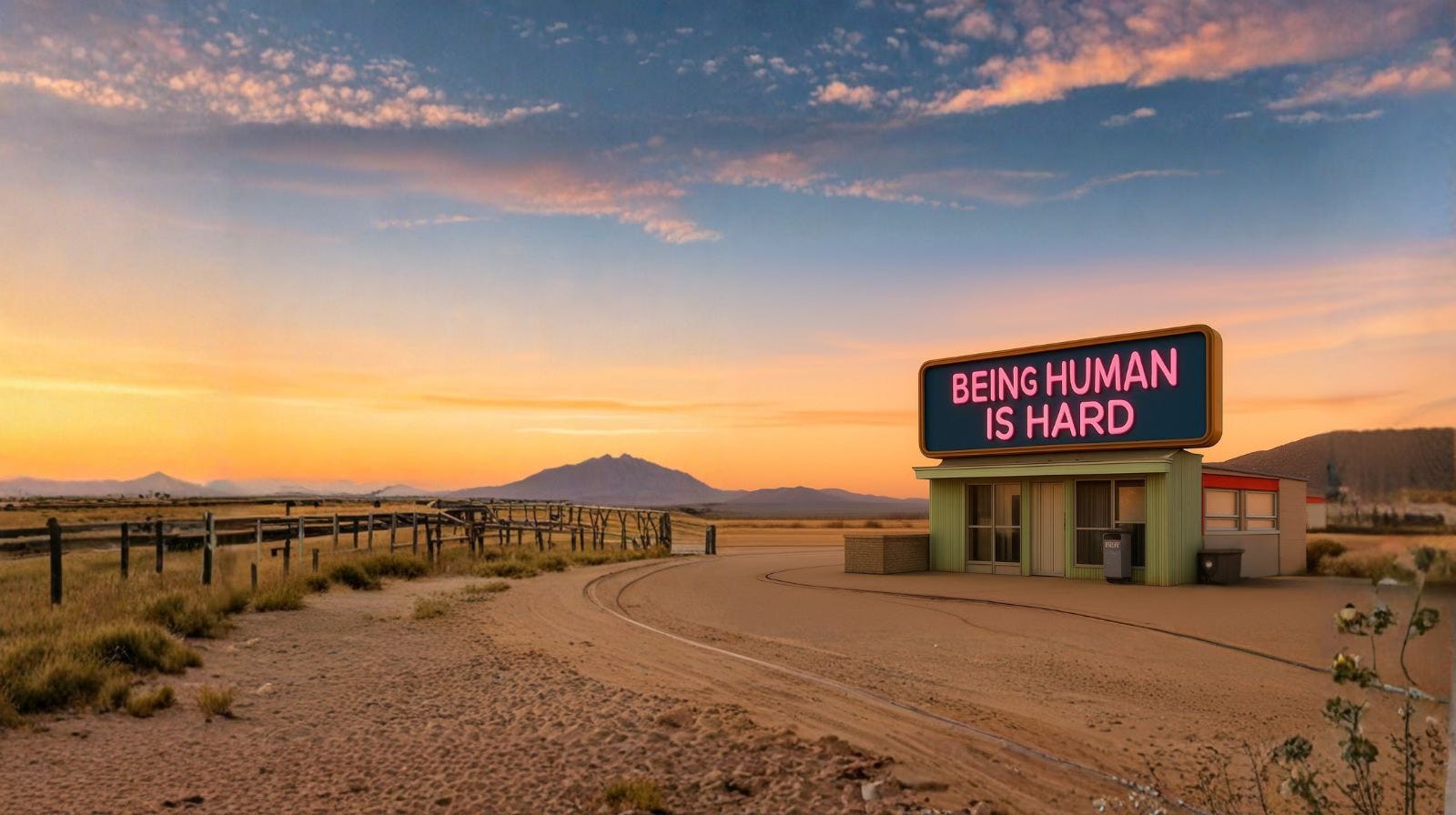
So I started creating a graphic to match the vibe of the phrase. I knew the image needed to capture the emotions that can accompany the challenging side of being human (fear, loneliness, frustration...). For me, this desert outpost with a neon beacon captured those sentiments almost perfectly. The sign felt validating, but as I worked on the image, I realized that I was creating something a bit different.
The little inn needed to have a light on in the window.
The road needed to keep going so we could move forward when we felt ready.
The fence needed to show that there was something more, even if we couldn’t see it.
The plants in the foreground needed to show life and viability in the midst of desolation.
The image became a place to pause, reflect, and breathe. It reminded me that alongside the hard there was always hope. As a result, I experienced a welcoming feeling. So I changed the title and shifted the focus from the hard to the hope. With the help of a few trusted people in my life, I created a new title—one that is more aligned with everything I write, as well as who I am.
“Alongside the hard there is always hope.”
I am always exploring what it means to be human in almost everything I do. I like to write about things that help to normalize the human experience in all its messiness and beauty. As I said earlier, it’s our stories that allow us to remember hope. They are how we create hope for others and rediscover it ourselves. Yes, being human is hard, but together, we can do hard things. Thankfully, just like storytelling, hope is an integral part of being human.
So, with that I can now say: Welcome to Everyday Hope. I’m glad you’re here.